
Lecture by Edward Vickers: “Dissolving Hong Kong – Public History and National Education since the 2020 National Security Law”
This talk by Edward Vickers (Kyushu University) analyses the stepping up of ‚National Education‘ in Hong Kong following the mass protests of 2019-2020. It examines how the National Security Law of 2020 has led to a rapid and sweeping ‚mainlandisation‘ of identity discourse in schooling and the heritage sector. Changes to school curricula are significant, but need to be understood in the context of a draconian crackdown on media freedom, civil society and teachers‘ autonomy. The shift in public discourse is especially evident in museums and the heritage sector, where the local past is increasingly refracted through the prism of Chinese nationalism and ’securitisation‘. Recent changes include a new focus on commemoration of China’s ‚War of Resistance‘ against Japan; the opening of a grand new ‚Hong Kong Palace Museum‘ celebrating the imperial high culture of northern China; and forceful promotion of ‚National Security Education‘, invoking threats of foreign imperialism and subversion. Crucially, the intensified promotion of state-centred Chinese nationalism is also tied to an agenda of ever-closer integration of Hong Kong within a ‚Greater Bay Area‘ encompassing Shenzhen, Guangzhou and neighbouring cities. The reorientation of local identity consciousness is supported by demographic, economic and infrastructural changes that, taken together, threaten to dissolve Hong Kong’s distinctiveness in a solvent of monolithic ‚Chineseness‘.
Speaker Edward Vickers, Associate Professor of Comparative Education, Department of Education, Kyushu University
Lecture by Lin Xin: „Exhibited Secrets: Sentimental Jewelry as a Medium of Death and Intimacy“
This talk defines sentimental jewelry as a medium that connects death and intimacy. Historically, it revisits Victorian death culture and traces later discourses surrounding sentimental jewelry; analytically, it explores how the concept helps articulate mediated death and the memory of loss. Across these layers, the materiality, indexicality, and modes of display—as “exhibited secrets” (Christiane Holm), ranging from hairwork to miniature portraits—reveal how mourning and intimacy are negotiated through material objects. Sentimental jewelry is marked by a double fragility, namely material and meaning, as well as by a value rooted in these fragilities and in intimacy rather than in price. The paper closes with the Chinese notion of Nianxiang 念想 as a cross-cultural lens.
Speaker: Lin Xin, University of Nanjing
Tuesday, November 18, 2025, 6-8 p.m. in Erlangen, Artilleriestraße 70, room 00.112
Visiting Professorship at Collège de France
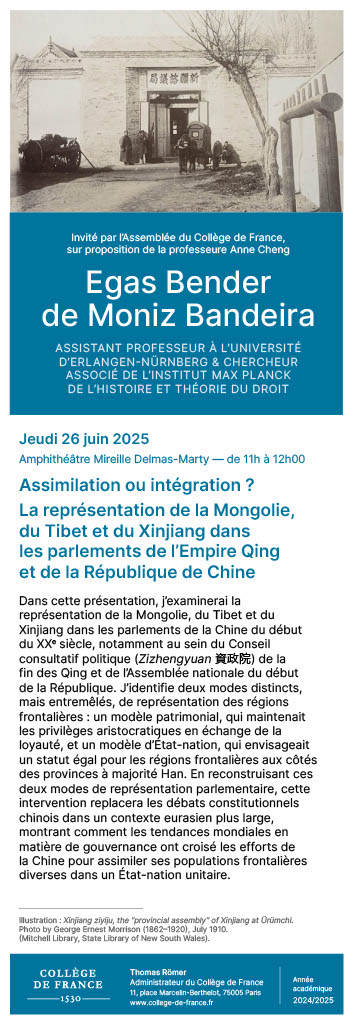
In June 2025, Egas Bender de Moniz Bandeira was a guest lecturer at Collège de France in Paris, where he delivered the talk «Assimilation ou intégration ? La représentation de la Mongolie, du Tibet et du Xinjiang dans les parlements de l’empire Qing et de la République de Chine» [Assimilation or Integration? Representing Mongolia, Xinjiang, and Tibet in parliaments of the late Qing Empire and the Republic of China].
Link to the talk:
Visiting Fellowship at the Polish Academy of Sciences
Between 21st and 25th October 2024, Egas Bender de Moniz Bandeira was a visiting scholar at the Institute for Political Studies at the Polish Academy of Sciences. He gave three seminars and talks as part of the visit:
1. ‘Hunting Genghis Khan’s Posthumous Life.’ Centre of Central Asian Studies, Faculty of History, Adam Mickiewicz University, Poznań, 24 October 2024 (with Katarzyna Golik).
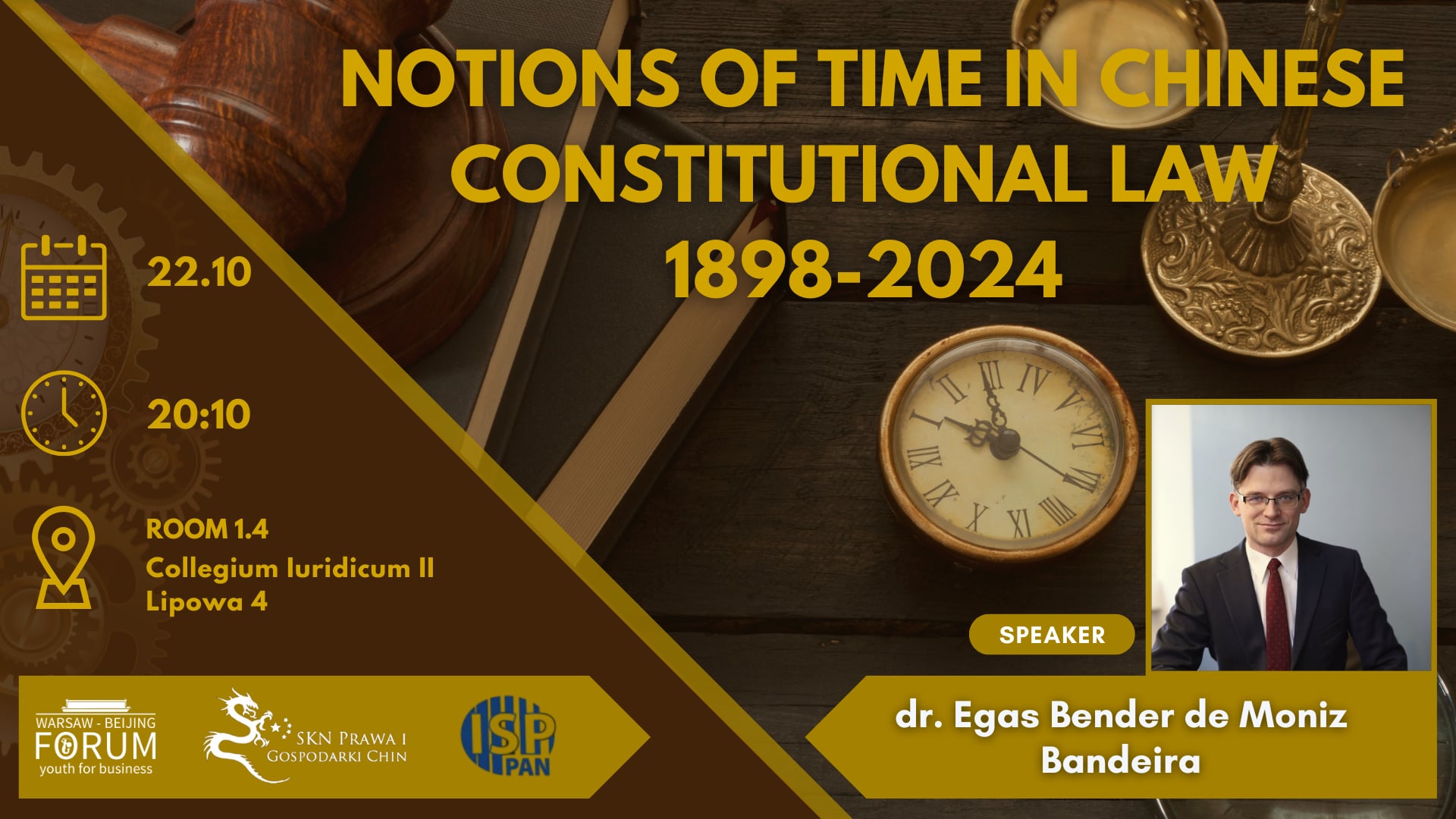
2. ‘Notions of Time in Chinese Constitutional Law, 1898–2024.’ Warsaw-Beijing Forum, Department of Law and Administration, University of Warsaw, 22 October 2022.
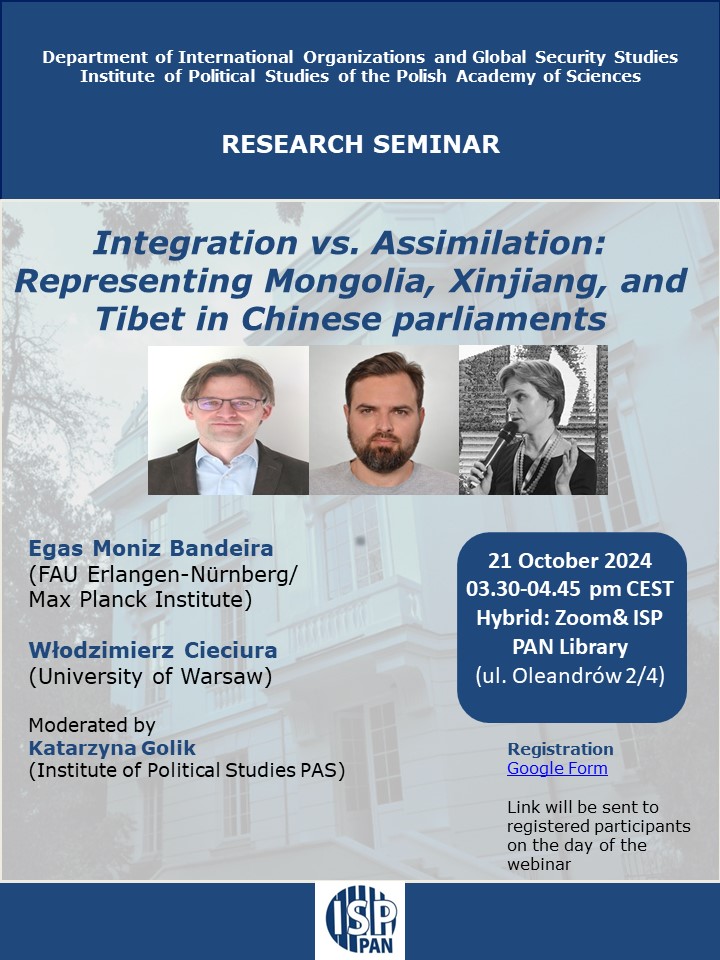
3. ‘Integration vs. Assimilation: Representing Mongolia, Xinjiang, and Tibet in Chinese parliaments.’ Institute for Political Studies of the Polish Academy of Sciences, Warsaw, Poland, 21 October 2021 (with Włodzimierz Cieciura).
Lecture by Zhang Ke: „Inventing Humanism in Modern China“
Appearing as early as 1900s, both rendao zhuyi and renwen zhuyi are the Chinese renderings of humanism. For the Chinese intellectuals during the Late Qing and Early Republican period, these two terms represented a modern value of humanity and human dignity but have different implications. Rendao zhuyi once gained tremendous popularity among the May-Fourth scholars, but later renwen zhuyi rose and entailed a strong criticism of rendao zhuyi. This lecture will discuss the different translations of humanism and the associated controversies. Further, it will delineate the four stages of the invention of humanism in modern China.
Ke ZHANG 章可is an Associate Professor in the department of History at Fudan University, China. He also serves as associate directors of the International Center for Studies of Chinese Civilizaiton (ICSCC) and the Asia Research Center (ARC) at Fudan. He received his Ph.D. from Fudan University in 2009. His research interests include modern Chinese intellectual history, conceptual history and the global history of cultural exchange.
He is the author of The Conceptual History of ‚Humanism‘ in Modern China,1901-1932 (2015, in Chinese), the editor of The Transformations of Ideas and Knowledge in Modern China (2018, in Chinese), and the co-editor of The Production of Knowledge and the Politics of Culture in Modern China (2014, in Chinese), and Stray Birds on the Huangpu: A History of Indians in Shanghai (2018, Bilingual, English and Chinese). He has published more than fifty articles in various journals, edited volumes and other books.
Lectures in Kyōto and Tōkyō
In May 2024, Marc Andre Matten gave three talks upon invitation to the University of Tōkyō, Kyōto University, and Dōshisha University.
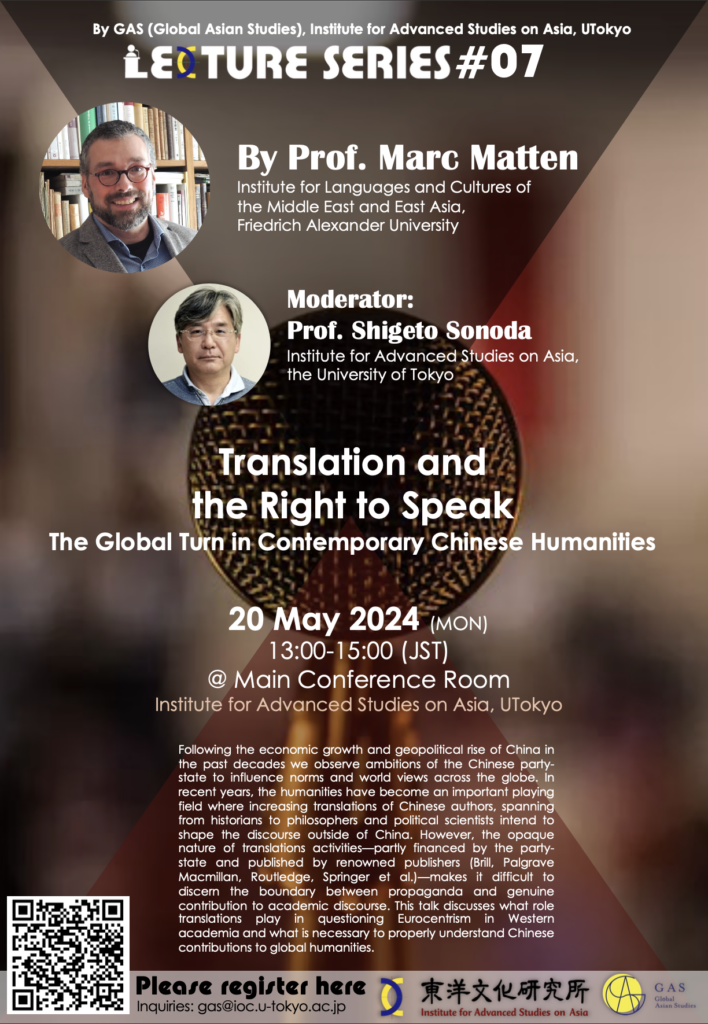
20 May 2024: “Translation and the Right to Speak–The Global Turn in Contemporary Chinese Humanities”, Institute for Advanced Studies on Asia, University of Tōkyō.
23 May 2024: “Struggling against Eurocentrism in Global Academia” (in Chinese), Graduate School of Global Studies, Dōshisha University.
24 May 2024: “Nostalgia among travelers to China and their travelogues in the 19th and 20th centuries: Sven Hedin as an example” (in Chinese), Research Center for Modern and Contemporary China, Institute for Research in Humanities, Kyōto University.
Lecture by Egas Moniz Bandeira: „Changing Legal Professions in China, Japan, and the Ottoman Empire in the Long 19th Century: Towards a Historical Comparison“
On 15 December 2023, Egas Bender de Moniz Bandeira gave a talk at the Institute for Advanced Studies on Asia of the University of Tōkyō on the topic ‘Changing Legal Professions in China, Japan, and the Ottoman Empire in the Long 19th Century: Towards a Historical Comparison.’
Presentation by Marc Andre Matten at Fourth International Conference on Chinese Translation History
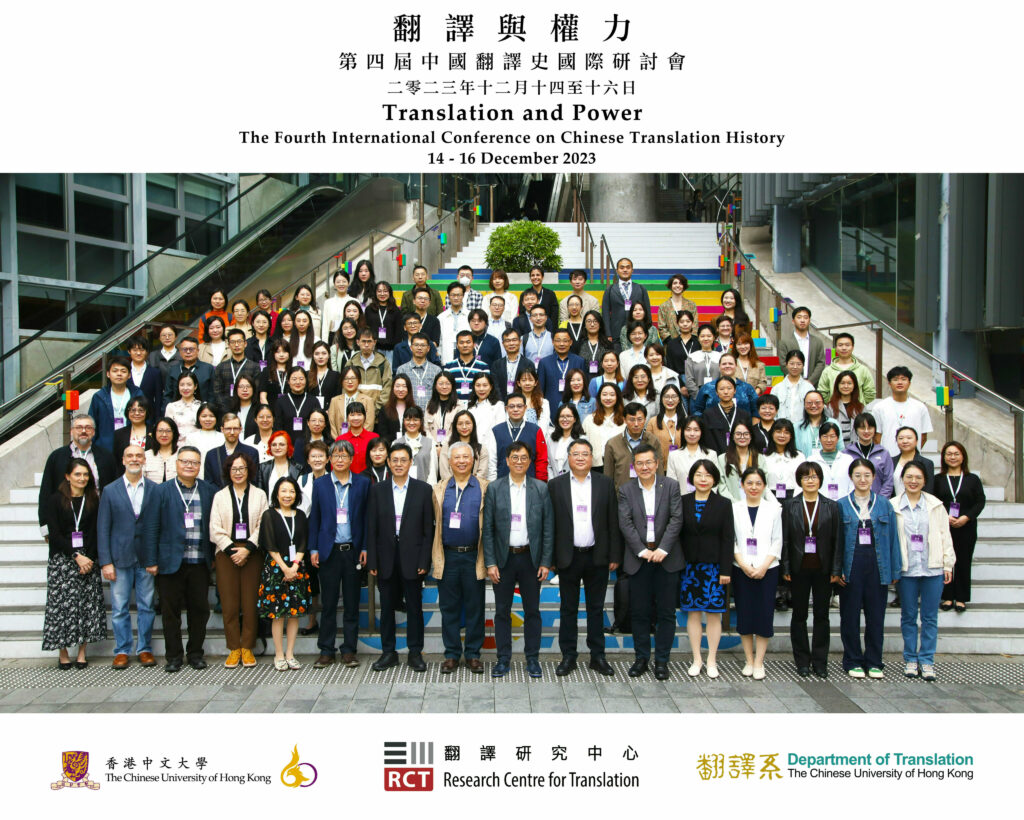
In December 2023, Marc Andre Matten gave a lecture on “Global Translations and the Quest for Soft Power—The Case of Contemporary China” at the Fourth International Conference on Chinese Translation History (Chinese University of Hong Kong), 14-16 December 2023.
Since its inception, postcolonial criticism has argued that when the colonizer talked about the colonial subject, his or her statements were undoubtedly an expression of hegemony and control. For instance, the infamous book Chinese Characteristics (1894) written by the missionary Arthur Smith has long been criticized for orientalizing China. Scholars such as Lydia Liu, Paul Cohen, and Prasenjit Duara have continuously highlighted that Chinese voices need to be heard to write a history that is no longer hegemonic. The strengthening of translingual and transcultural debates is a relevant step when establishing a truly global academic community where power hierarchies have been flattened or even overcome. Until today, this ideal has not been realized. A quick look at the academic publication market reveals not only a persisting Western centrism where North American publications dominate but also a troublesome asymmetry in terms of translation. Much more Western publications appear on the Chinese book market than the other way around. As a result, thereof, institutions such as the Chinese Fund for the Humanities and Social Sciences have in recent years started to provide funding for translating more Chinese academic books into foreign languages (not limited to English). In the reading of Foucault and the postcolonial critique, such efforts can be read as expressions of resistance and ideological subversion, which is however not unproblematic. This paper discussed the necessary conditions for these books to be read outside China and to strengthen Chinese soft power in academic discourse in the humanities.
Lecture by Marc Andre Matten: “The Power of Translation—How to Write a post-Eurocentric Global History?“
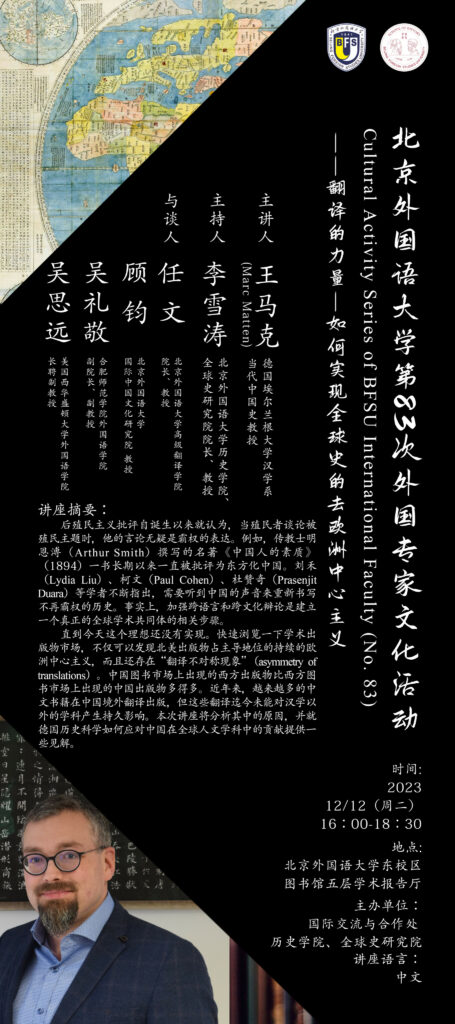
The talk, titled “The Power of Translation—How to Write a post-Eurocentric Global History?“ (翻译的力量—如何实现全球史的去欧洲中心主义, given in Chinese),—attracting an audience of more than 150 persons—introduced the project Writing History with China to graduate students and scholars of the Institute of Global History at Beijing Foreign Studies University and highlighted the need to be cautious in choosing texts when translating in translingual and transcultural contexts.
A news report on the event can be found here.
Keynote by Marc Andre Matten: “Viewing Chinese Students abroad in Global History from Multiple Perspectives”
In May 2023, Marc Andre Matten gave the keynote speech at the Symposium on the History of Scholarly Exchange and the Formulation of Modern Disciplines in China, organized by the Institute of Global History at Beijing Foreign Studies University. The keynote, titled “Viewing Chinese Students abroad in Global History from Multiple Perspectives” (从多视角看全球史中的留学生现象, in Chinese), highlighted the persistence of methodological nationalism in global history research and argued for a stronger multiperspectivity in research.
Guest Professorship at Institute of Global History (Beijing Foreign Studies University)
In the academic year 2023, Marc Andre Matten gave four talks (in Chinese) at the Institute of Global History, Beijing Foreign Studies University, with the following topics:
- Shanghai as a Global City—the Perspective from Europe (上海作为全球城市—欧洲的视角)
- China Travellers in Nineteenth and Twentieth Century and their Nostalgic Travelogues (19-20世纪来中国旅游者及其旅游记的怀旧感)
- The Significance of the Year 1989 in Global History (1989年的全球史意义)
- A Transcultural History of Concepts for Global History Research (全球史研究的跨文化概念史)
Introduction to „Digital Collections on Chinese Studies“ Database
We are very pleased to welcome Dr. He Yan from the China Documentation Centre (CDC) at George Washington University.
She will present the database „Digital Collections on Chinese Studies“ on Tuesday, July 27, 2022, between 10 am and 12 pm.
The new databank allows scholars to locate institutions, archives, and digital collections in the field of Chinese Studies and lend them an overview of respective holdings of books, newspapers, journals, archival materials, image collections, and more. The database provides maps of the respective locations, detailed information, and links to the respective institutions, and search functions with detailed filtering options.
Guest Professorship at Institute of Global History (Beijing Foreign Studies University)
In the academic year 2022, Marc Andre Matten gave two talks (in Chinese) at the Institute of Global History, Beijing Foreign Studies University, with the following topics:
- The “West“ as Historical Actor? The Genealogy of anti-Eurocentrism in Modern China (以“西方”为历史主体?现代中国的反欧洲中心论系谱)
- Structure and Agency in Historical Science—The Contribution of Digital Methods in the Humanities (历史学的结构和主体—以数字人文科学为例)
Lecture by Takii Kazuhiro: “Thinking about ‚Japaneseness‘ from the Perspective of Global History: the Constitutional History of Japan as a Case Study“
On March 27th 2023, Prof. Takii Kazuhiro from the International Research Center for Japanese Studies in Kyōto visited Erlangen to give a lecture:
“You will notice that our constitution is, in its fundamental principle, entirely Japanese.” Thus wrote Hirobumi Ito, who guided the shaping of Japan’s first constitution, the Imperial Constitution of Japan. He wrote this to Lorenz von Stein, professor of Staatswissenschaft at the University of Vienna, on March 1, 1889, shortly after the promulgation of the Imperial Constitution. This Constitution was established on the basis of the study of Western constitutionalism, but it was announced as being an entirely original Japanese document. Focusing on the creation of a uniquely Japanese Emperor System, I will examine Japan’s attempts at that time to create a Japanese-style constitution while introducing Western constitutionalism, and the historiography of this decisive moment in Japanese history.
“You will notice that our constitution is, in its fundamental principle, entirely Japanese.” 日本最初の憲法である大日本帝国憲法が発布された直後の1889年3月1日、憲法の制定を指導した伊藤博文は、このようにウィーン大学の国家学の教授ローレンツ・フォン・シュタインに書き送った。日本の帝国憲法は、西洋の立憲主義の学習のうえに成立したが、それはentirely Japaneseなものと謳われた。西洋の立憲主義を導入しながら、日本的な憲法を作ろうとした当時の日本の試みを、日本独自の天皇制の構築に焦点をあわせて考察する。
Podiumsdiskussion: Professionelle „China-Versteher“ zwischen allen Stühlen? Die Sinologie im Spannungsfeld von Politik, Moral und öffentlicher Erwartungshaltung
Im Rahmen der XXXII. Jahrestagung der Deutsche Vereinigung für Chinastudien e. V. (DVCS) zum Thema Wissensasymmetrien: China als Akteur und Objekt (globaler) Debatten (19.-21.11.2021, Freiburg im Breisgau) nimmt Marc Matten teil an der Podiumsdiskussion Professionelle „China-Versteher“ zwischen allen Stühlen? Die Sinologie im Spannungsfeld von Politik, Moral und öffentlicher Erwartungshaltung. Zusammen mit Maximilian Mayer (Bonn), Barbara Mittler (Heidelberg) und Marina Rudyak (Heidelberg) werden die Wissensasymmetrien in den Feldern Politik, Wirtschaft und Wissenschaft beleuchtet und gefragt, was wir von China eigentlich (noch) nicht wissen, aber eigentlich wissen müssten, und welche Rolle die Sinologie dabei spielen kann.
Programm s. diese pdf-Datei.
Colloquium on Global History at FAU (Winter Term 2021-22)
28.10.2021
Aaron Moore (University of Edinburgh): My World in War and Revolution: A Comparative History of the Modern Diary in the East and West
09.12.2021
Roberto Zaugg (Universität Zürich): Stoffe, Perlchen, Pferdeschwänze. Portugiesischer Handel in Westafrika
16.12.2021
Ruth Mostern (University of Pittsburgh): What’s in a Name? The World Historical Gazetteer and the Semantics of Space and Place
20.01.2022
Lucy Delap (Cambridge University): Black feminists and the global South in late twentieth century Britain
Thursdays, 6:15– 7:45 p.m.
Colloquium on Global History at FAU (Summer term 2021)
29 April 2021
Dominic Sachsenmaier (University of Göttingen) (German): Mehr als ein Kulturkontakt: Globalhistorische Perspektiven auf die Geschichte des chinesischen Christentums im 17. Jahrhundert
6 May 2021
Anne Kwaschik (University of Konstanz) (German): „Toward total world knowledge…”—Area Studies in den USA, 1920er bis 1990er Jahre
20 May 2021
Pamela Kyle Crossley (Dartmouth College) (English): China and Eurasian Industrialization before 1600
24 June 2021
Alessandro Stanziani (EHESS, CNRS, Paris) (English): What is it Eurocentrism?
Thursdays, 6:15– 7:45 p.m.